The average job drew 244 applications in 2025. Your pre-screening interview questions decide which 10 your hiring manager meets, and which strong candidate never hears back.
That is up from 116 in 2022, while recruiting teams shrank 56% (Greenhouse). Give each applicant a 20-minute call, and you spend 81 hours on phone screening questions before your hiring manager meets anyone.
Now add AI: 39% of candidates used AI in their applications, and 29% of those used it to write assessment answers (Gartner). Polished writing is cheap now, so a well-written answer tells you less than it used to.
Here are 25 questions, a 1-4 scale and the legal limits.
Key takeaways
- How do I get through 244 applicants without 81 hours of calls? Put the deal-breakers in the form as pass or fail, then score 2 to 4 written or recorded answers about past work.
- Which questions show who will do the job well? What the person did last time, scored against answers you described in advance. A 2022 review ranked this kind of structured interview first.
- Do CV and interview scores rank people the same way? Often not: the top CV and top AI interview score belonged to the same candidate in 19.2% of 532 projects. That does not show which ranking predicts performance.
- What could get my company in legal trouble? Pay history, health before an offer, and in California, convictions before a conditional offer.
- Will candidates drop out of an AI interview? About 1 in 7 who start don't finish: 26.5% quit on a phone, against 10.8% on a laptop.
1. What should pre-screening interview questions tell me before I spend an hour interviewing someone?
They tell you 1 thing: whether this person is worth an hour of an interviewer's time. So they check the facts that would end an application, then score 2 or 3 signals: the skills the job depends on.
A narrow goal matters because 20 minutes can't test everything. It can stop 2 costly mistakes: an hour with someone who can never take the job, or a yes for someone who can't do it.
Say you're hiring a warehouse shift lead. If someone can't work nights, come on site or show a forklift licence, nothing else matters. What's worth scoring is how they ran a short-staffed shift and kept errors down.
In the funnel below, applications and CVs come in, and the knockouts in the form remove clear mismatches. A scored pre-screen of 15 to 20 minutes picks who goes forward, then the hiring manager goes deep before the offer.
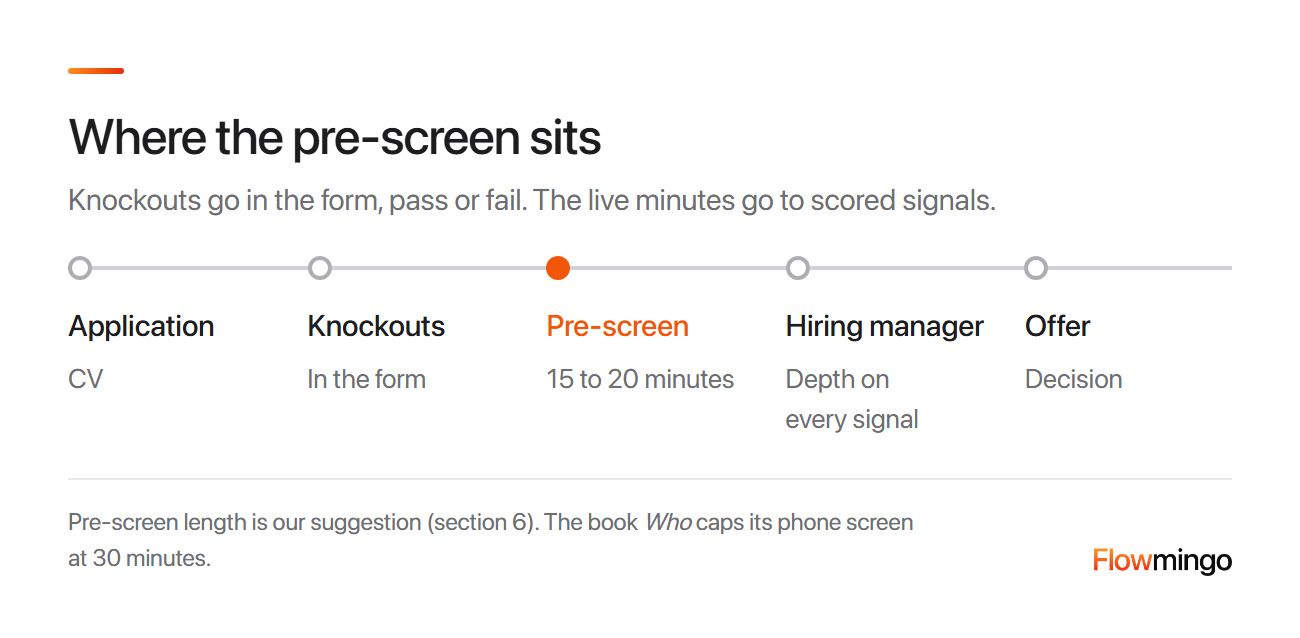
Where the pre-screen sits: after the knockouts in the form, and before the hiring manager's interview and the offer.
1.1 Who should run the screen: the recruiter or the hiring manager?
Split it by what each person checks, and agree the split before the role opens. A recruiter, a form or an AI interview covers the basics, so the hiring manager can spend their hour on depth.
| Pre-screen | Hiring-manager interview | |
|---|---|---|
| Run by | Recruiter, or a form or AI interview | Hiring manager and team |
| Checks | Knockouts, then 2 or 3 scored signals | Depth on every signal |
| Outcome | Advance, hold or decline | Offer or no offer |
2. How do I screen 200+ applicants without phoning every one?
Move the knockouts into the application form as pass-or-fail questions, and call no one who fails them. Then score 2 to 4 answers about past work, in writing or in a one-way interview that candidates record alone.
Imagine 240 people apply for a support role that needs weekend shifts. If 90 can't work weekends, the form removes them unread. Your pre-screening interview questions then go to 150 people, in writing, not 240 calls.
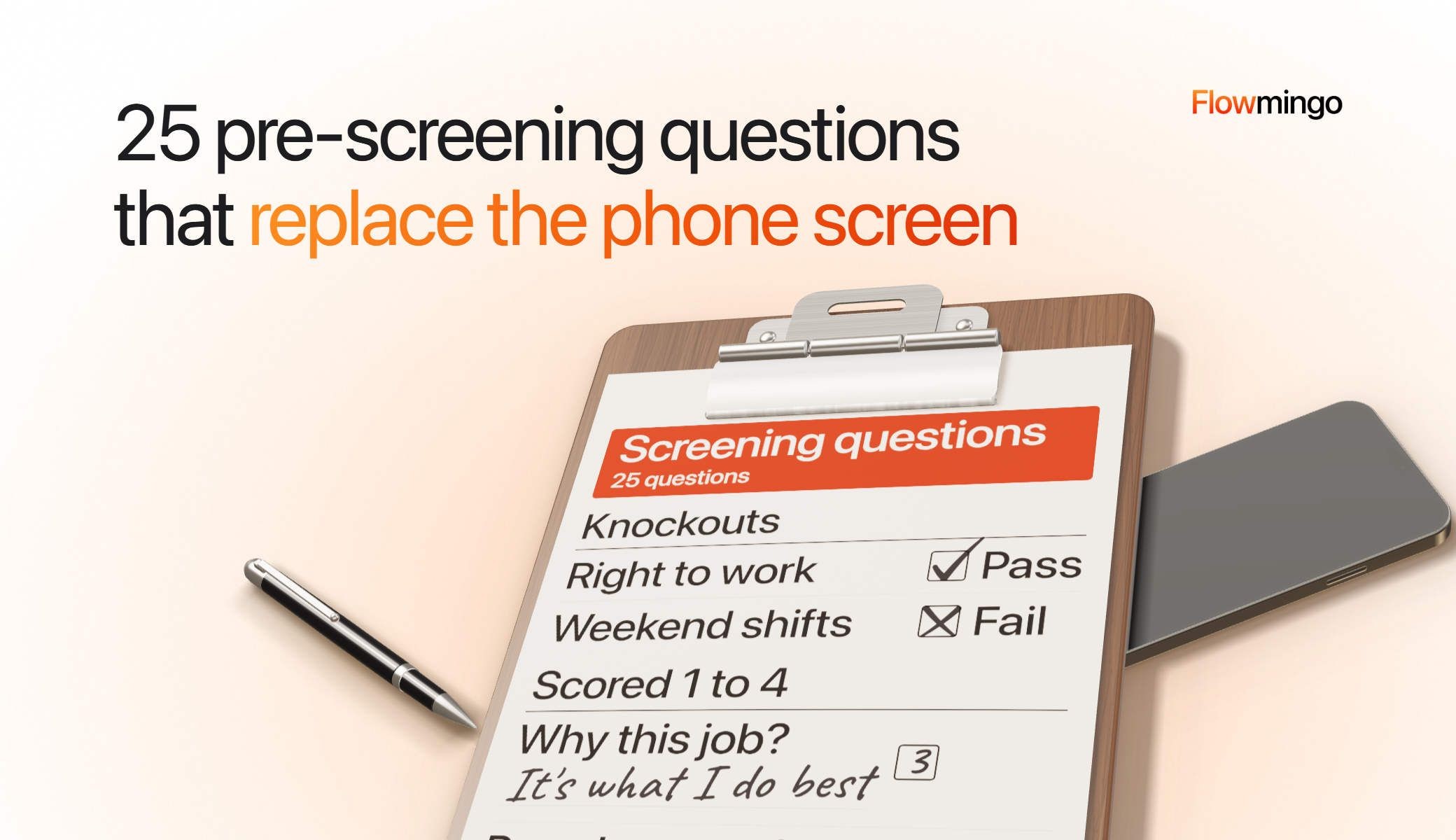
This works because the 2 kinds of question do different jobs, as the figure below shows. Knockouts are facts the job can't flex on, so they pass or fail: right to work, shifts, on-site location, a licence, the pay range.
Signals show how well someone would do the work, so each gets a score from 1 to 4.
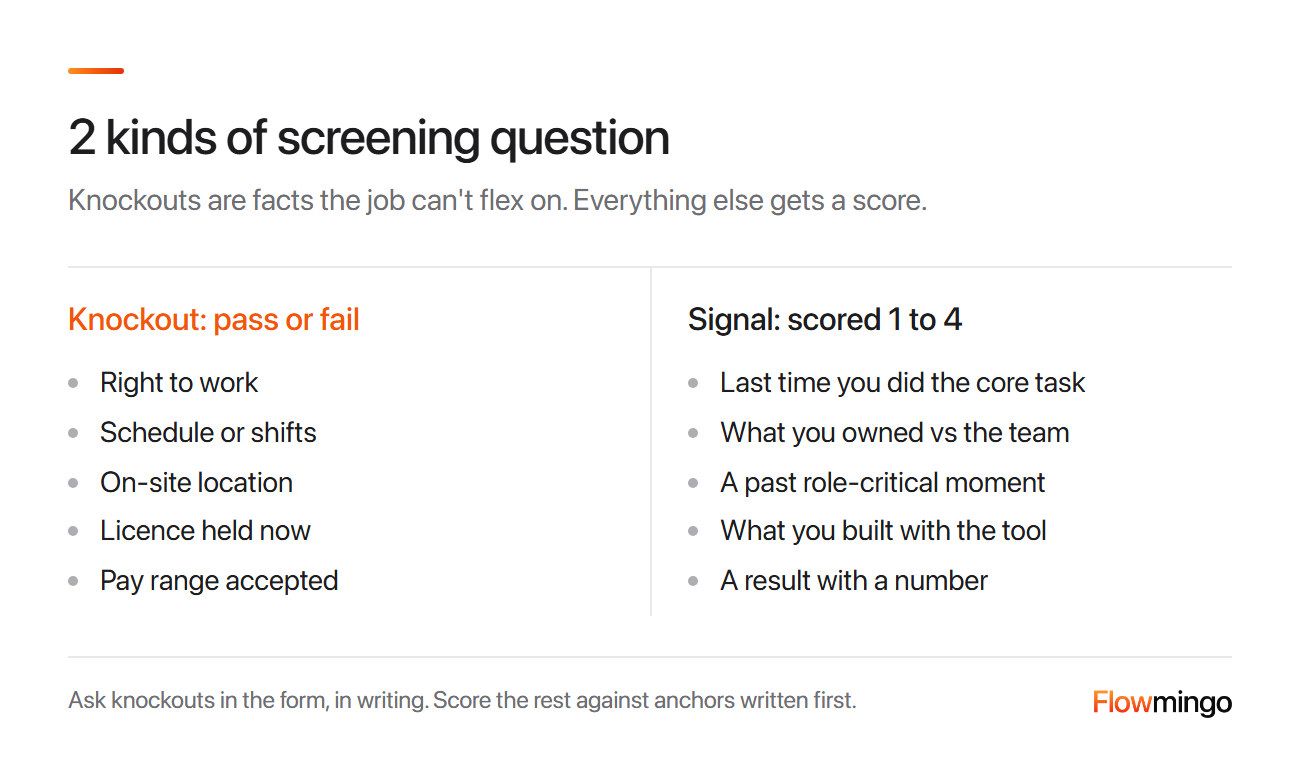
2 kinds of screening question: knockouts get a pass or a fail, and signal questions get a score from 1 to 4.
2.1 Which 6 knockout questions go in the form?
Ask these first, in writing, and set each passing answer in advance, so the bar can't move for a candidate you like.
| # | Question | Passes if |
|---|---|---|
| 1 | Can you work [days and hours]? | Yes |
| 2 | Can you work on site in [city] [N] days a week? | Yes |
| 3 | Are you authorised to work in [country]? Will you need sponsorship? | Yes; no sponsorship if you can't offer it |
| 4 | The range is [X to Y]. Does that work for you? | Yes |
| 5 | When could you start? | Inside your window |
| 6 | Do you hold a current [licence]? | Yes |
Ask about the right to work, never citizenship, because the job needs the first, not a passport. Keep knockouts to facts you can check. "Do you have 3 years of Excel?" invites a yes from everyone, so ask what they last built in Excel, and score it.
3. Which pre-screening interview questions predict who will do the job well?
Ask what the candidate did last time, and score it against anchors: 1-line descriptions of a poor to outstanding answer, written in advance. Structured interviews like this came first in a foundational 2022 review of hiring research.
Sackett and colleagues found structured interviews predicted job performance more than twice as well as unstructured, chatty ones. Results varied a lot, so how you write the questions matters as much as the label.
Past work makes the best material, because anyone can describe a plan but recalling the last crisis takes real memory.
3.1 Recent work: 5 scored questions
Score these from 1 to 4, and note the red flag if you hear it.
| # | Question | Tests | Red flag |
|---|---|---|---|
| 7 | Walk me through the last time you did [core task], step by step. | Task experience | No steps |
| 8 | Which part did you own, and which did the team own? | Scope | Can't separate the 2 |
| 9 | Tell me about a time [role-critical situation] happened. | Judgement | Says what "you would" do |
| 10 | What did you build with [tool] in your last role? | Tool depth | Names it, no use |
| 11 | What result are you proudest of, with a number? | Impact | Generalities, no number |
For example, "I would stay calm and escalate" is a plan, not a memory. It scores low on question 9, however sensible it sounds.
3.2 The 4-question "Who" screen
The hiring book Who, by Geoff Smart and Randy Street, offers a different screen. It asks 4 fixed questions by phone, in 30 minutes at most (Smart's 81-second video).
- What are your career goals?
- What are you really good at professionally?
- What are you not good at or not interested in doing professionally?
- Who were your last 5 bosses, and how will they each rate your performance on a 1-10 scale when we talk to them?
The book calls question 15 the "threat of reference check". The authors' reasoning is that people describe their weak spots more honestly when they know you'll call their old bosses.
The book reads a predicted rating of 8 to 10 as good, 7 as neutral and 6 or below as bad. Use this screen instead of 3.1, and only if you will really call references.
3.3 Motivation and role add-ons: 10 questions
The first 4 test whether they still want the job, and question 19 flushes out deal-breakers early. Then add 1 question for the role.
- What made you apply for this role?
- What do you know about the day-to-day work?
- Why are you looking to move now?
- What would make you turn down an offer from us?
- Sales: What was your quota last year, and what share did you hit?
- Engineering: Walk me through a bug you fixed, from report to release.
- Hourly or retail: Tell me about a shift when the team was short-staffed.
- Healthcare: Which registration do you hold, and where is it valid?
- Support: Tell me about a customer you couldn't help.
- Remote: How many hours of overlap with [time zone] can you commit to?
3.4 Which classic questions should you stop asking?
Drop "tell me about yourself", "greatest weakness", "greatest strength" and "years of experience". Laszlo Bock, who ran people operations at Google, calls the first 3 "worthless".
A review pooling 81 samples of workers found that past work experience told employers almost nothing about performance, and nothing about who would stay. So ask what someone did, not for how long.
Bock's reason is confirmation bias: in an open interview, we mostly hunt for proof of our first impression. Our own data, in the card below, shows that a CV and an interview often rank people differently.
Flowmingo data · 34,114 candidates · 745 projects · 379 companies · Jul 2025 to Sep 2026
- 19.2% of 532 projects: the top interview score and the top CV score went to the same candidate.
- 47.0% of those top interview scorers were outside the top 20% of CV scores in their project.
- 54.9% of the 3,684 candidates who later scored 8 or more out of 10 (2,022) would have been cut by a top-20% CV shortlist.
Both are Flowmingo AI scores, not job performance, and interviewed candidates are a selected group. This shows a different ranking, not which is right.
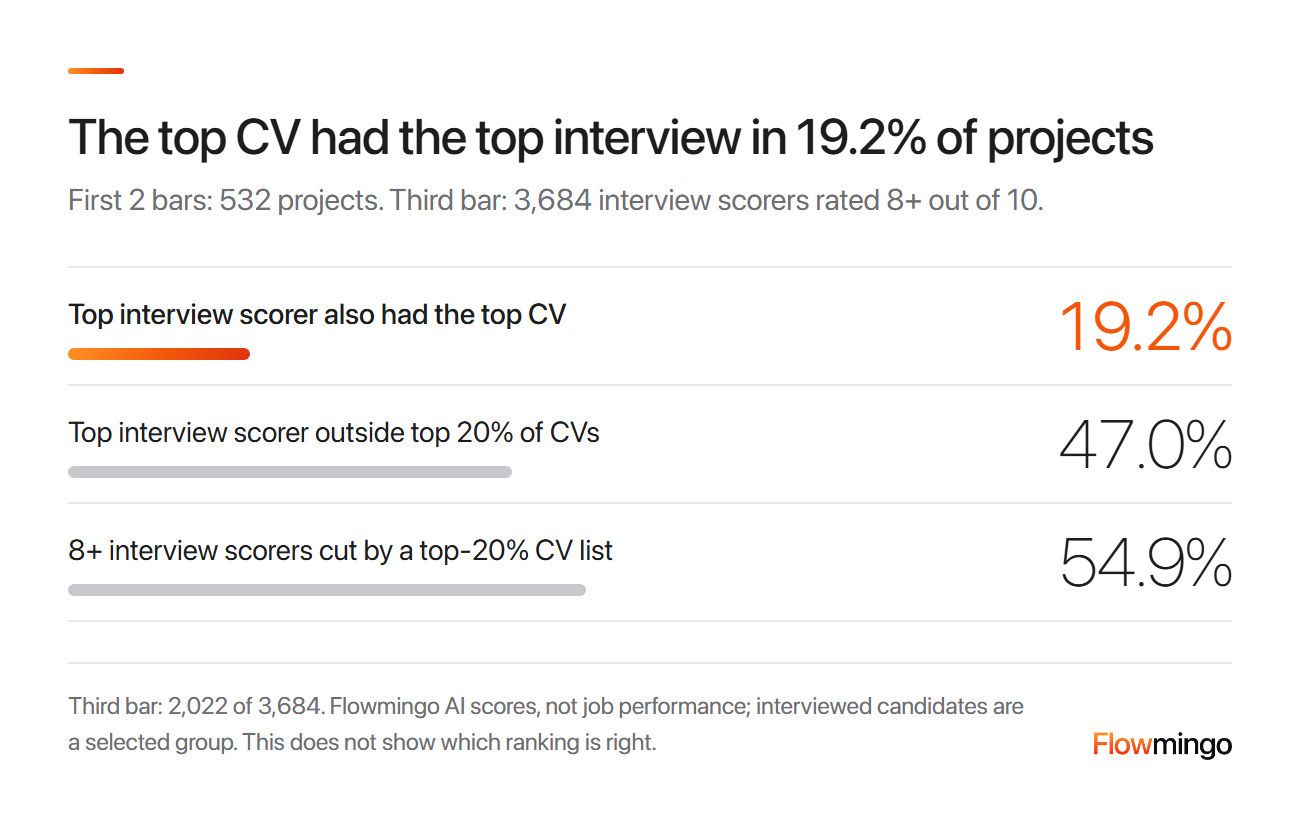
Top CV vs top interview: 1 candidate topped both rankings in only 19.2% of 532 projects.
A top-fifth CV shortlist would have excluded the highest AI interview scorer in almost half of these projects. Gather another kind of evidence, but do not treat this as proof that the interview ranking is right.
4. How do I spot AI-written answers or fake candidates before the interview?
Often you can't tell from the wording, so test the substance instead. Ask for evidence: the part they owned, the number and what went wrong.
Because AI can generate plausible specifics, detailed answers still need checking and, where relevant, independent verification.
Say a sales applicant claims they "grew revenue through strategic partnerships". Your written question should already ask which partnership, how much revenue and what went wrong. Check important claims rather than treating detail alone as proof that a story is real.
Faking predates AI. In Levashina and Campion's foundational 2007 study, over 90% of undergraduate job candidates faked in some way, from polishing a story to near-lies. They were students, so treat it as a signal, not proof.
The same study found that past-behaviour questions, such as 7 and 9, resisted faking better than hypothetical ones. Follow-up questions increased faking, so write the specifics into the question itself, as the sales question above does.
In Gartner's 2025 survey, 6% of candidates admitted to interview fraud, posing as someone else or having someone pose as them. Gartner's advice: say upfront which AI use you accept, and keep identity checks through to the offer.
How Flowmingo helps
Flowmingo's AI Interviewer flags tab switches, a second window, screenshot shortcuts, an extra monitor and missing or extra faces. It shows them for your review, and they never change the score.
5. How do I get everyone who screens to score pre-screening interview questions the same way?
Score each answer alone, 1 to 4, against anchors you wrote before the first call, then total them on a scorecard. The total, not your overall feeling, decides who goes forward.
Daniel Kahneman, the Nobel-winning psychologist, learned what general impressions are worth in 1955, fixing the Israeli army's recruit interview. They predicted almost nothing: about .10, on a scale where 1 is perfect.
Once interviewers rated 6 traits separately, that figure rose to close to .30, 3 times as high.
The book Noise, which Kahneman co-wrote, puts it in plain odds. If all you know is that candidate A interviewed better than candidate B, the chance A performs better is only about 56 to 61%. A coin toss gives you 50%.
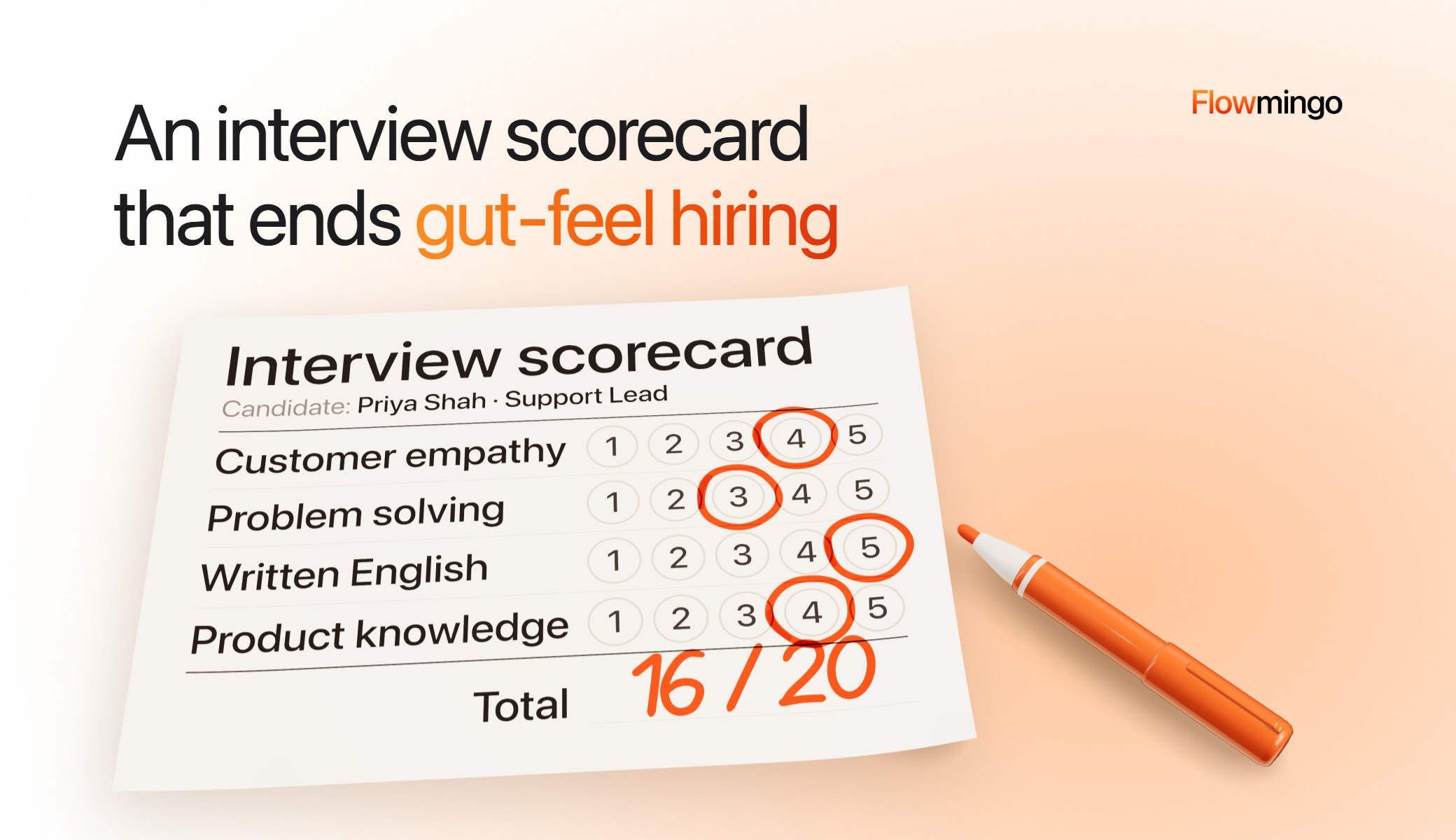
The scorecard below scores questions 7, 8, 9 and 11 from 1 to 4, for a total out of 16. Listen for the steps, their own part, a specific past moment and the number.
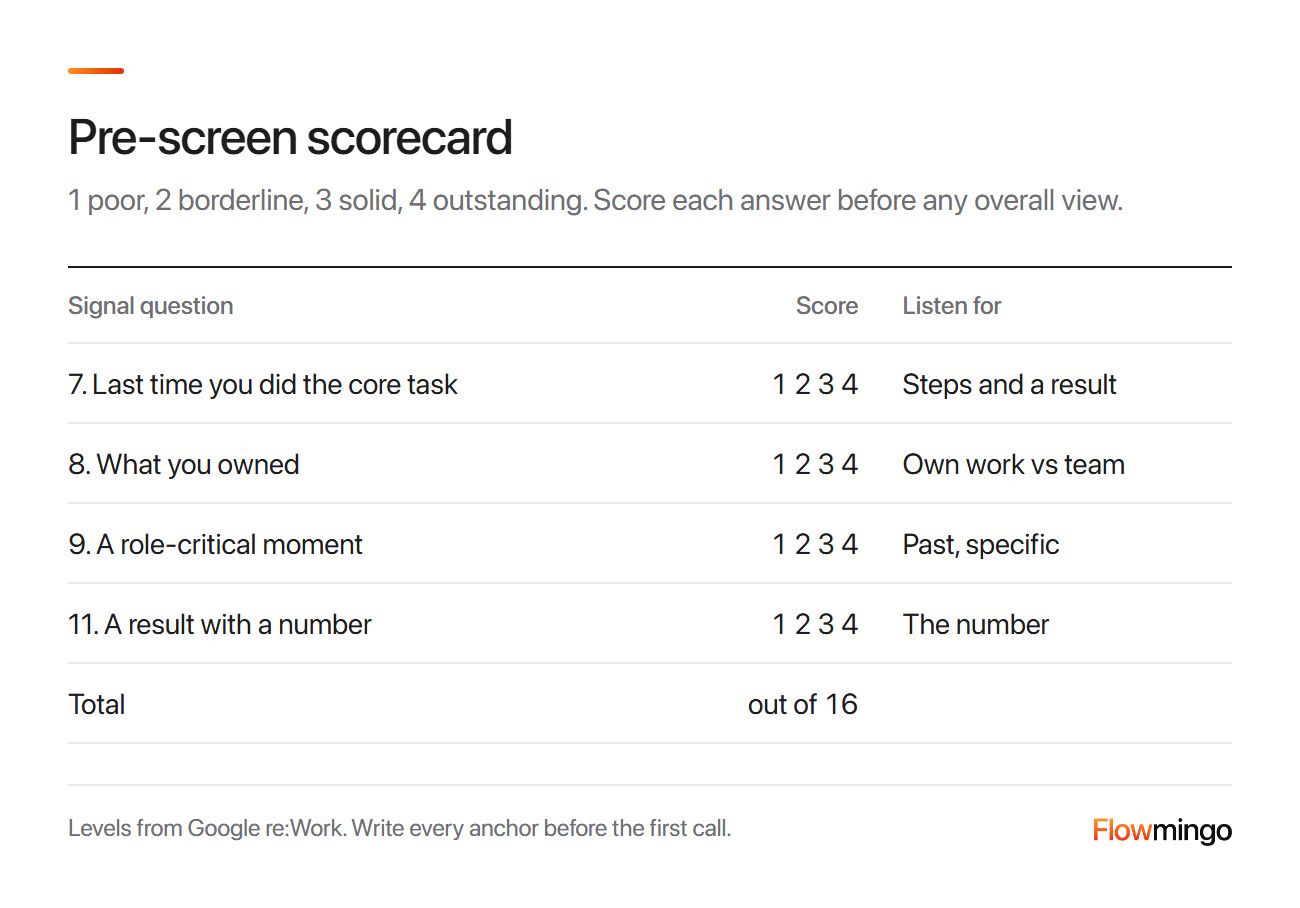
Pre-screen scorecard: 4 signal questions, each scored 1 to 4, for a total out of 16.
Iris Bohnet, a Harvard economist, adds 1 habit: score every answer to question 7 before any answer to question 8.
In her lab experiment, people judging candidates one at a time favoured men over equally skilled women on a maths task. Side by side, the gap disappeared.
The pooled scores below span different jobs. Set your advance line from your role's criteria and calibrated examples, not this overall distribution.
Flowmingo data · 86,638 candidates with an AI interview score · 2,574 companies · Jul 2025 to Sep 2026
- 6.4 out of 10 was the median score candidates got in a Flowmingo AI interview.
- 6.4% of candidates scored 8 or more out of 10 in the AI interview.
5.1 What does a 1-4 anchor look like for 1 question?
Google's re:Work guide names 4 levels: poor, borderline, solid and outstanding. Write 1 line per level for question 7, and agree them with any co-screener.
| Score | The answer to question 7 |
|---|---|
| 1, poor | Lists duties, no steps |
| 2, borderline | Steps, mostly the team's work |
| 3, solid | Own steps and a result |
| 4, outstanding | Own steps, a result and an unasked-for extra |
In Bock's tech-support example, a solid answer fixes the laptop battery as asked. An outstanding one also gets a spare, because the customer is about to travel. That extra step is what earns a 4.
6. How long should a screen take, and how many can I run in a row?
We suggest 15 to 20 minutes and 6 to 10 questions, with open answers capped at about 3 minutes. Run about 4 screens back to back, then take a break.
Length matters because both sides tire. Candidates lose patience with long sets of pre-screening interview questions, and screeners start deciding faster after a few screens in a row.
In Frieder and colleagues' study, 166 interviewers at a university careers centre noted when they made up their minds about 691 applicants. After about the 4th applicant in a row, they began deciding sooner in each interview.
That's why the authors suggest capping back-to-back interviews at about 4. The timings were self-reported, and the study didn't test whether quick decisions were worse, so treat 4 as a guide, not a rule.
For one-way or AI interviews, a study of 27,809 applicants from 33 companies in 11 countries linked more questions to applicants liking the process less. Those over 31 minded most.
Candidates performed best with a 3-minute answer limit in a 2025 mock-interview study of 185 people. At 1 or 5 minutes, answers got less clear and less relevant. It is 1 study, so treat 3 minutes as a sensible default.
7. Should an AI interview replace my phone screen, or will good candidates drop out?
Replace it when volume, shifts or time zones make calls impractical, and keep calls for small senior searches. Some candidates will drop out, so tell them upfront that you use AI and that a person reviews every result.
The table below shows the trade. A call costs 1 slot per applicant but lets a senior candidate ask their own questions. A one-way or AI interview costs only your review time, and applicants answer when it suits them.
| Format | Recruiter time | Best for |
|---|---|---|
| Phone or video call | 1 slot per applicant | Small senior searches |
| Form or chat | Set up once | Knockouts |
| One-way or AI interview | Review time only | Volume, shifts, time zones |
Greenhouse's 2026 survey of 2,950 job seekers shows the risk is real: 38% had walked away from a process over an AI interview. But 46% wanted a human option and 44% wanted to be told upfront, so how you introduce it matters.
For example, your invite could say: "The first step is a short AI interview you can take any time this week. A person on our team reviews every answer before any decision." If someone asks for a person instead, offer a short call.
How Flowmingo helps
Flowmingo's AI Interviewer asks the questions you approved, scores each criterion 0 to 10 with a written reason, and leaves the decision to you. The sample report below shows the format.
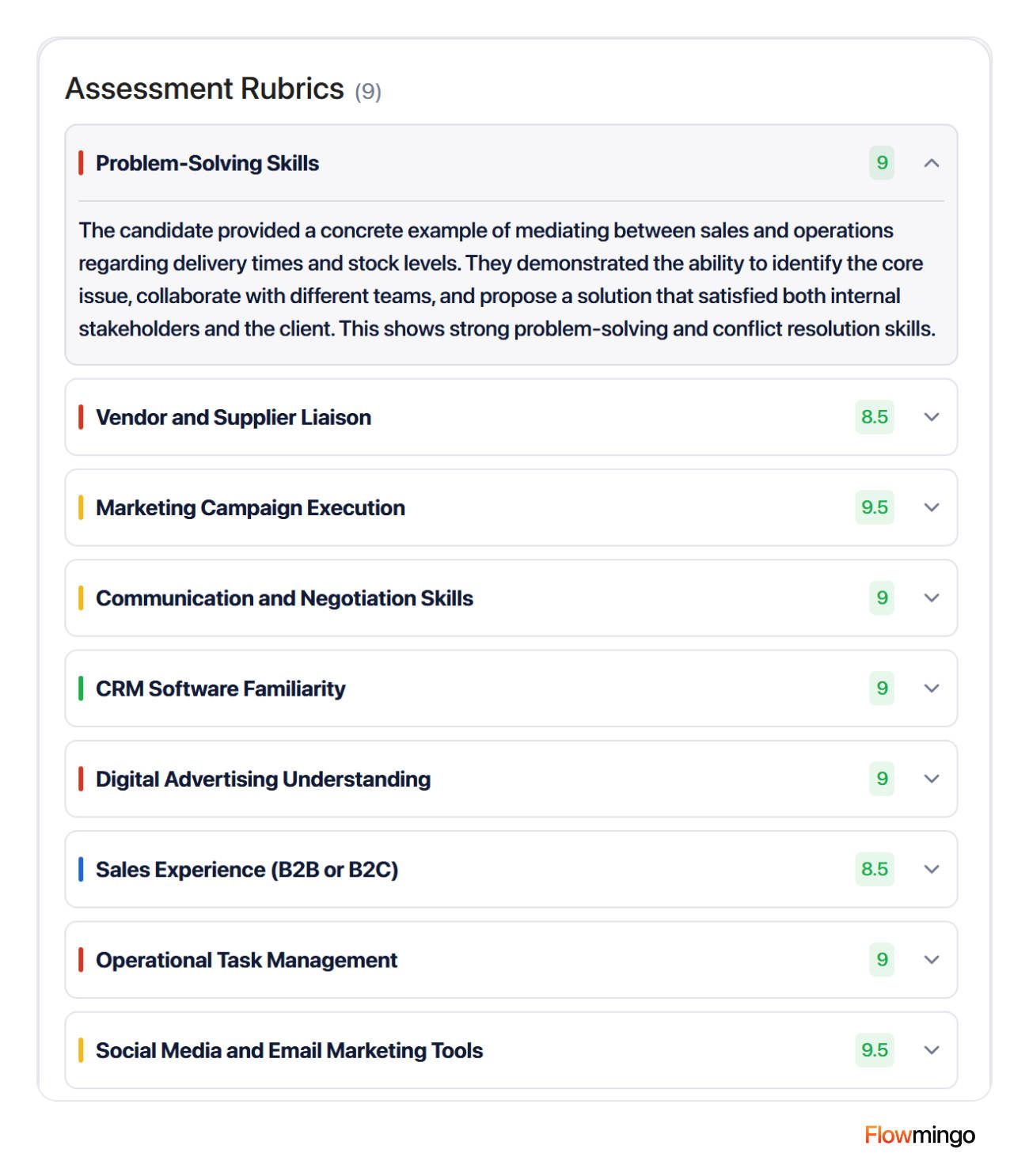
Sample AI interview report: each criterion scored 0 to 10, with its reasoning.
The device matters too. As the card below shows, fewer candidates finish on a phone than on a laptop. Phone users may differ in other ways, but suggesting a laptop in the invite costs nothing.
Flowmingo data · 49,323 AI interviews begun · 990 companies · 24 Jun to 20 Sep 2026
- 85.0% of the AI interviews begun were finished.
- 89.2% of AI interviews begun on a desktop or laptop were finished.
- 73.5% of AI interviews begun on a phone were finished (full data).
8. Can I ask candidates about salary, visa sponsorship, gaps or criminal records?
Ask about pay expectations and sponsorship where lawful; restrictions on pay history, citizenship, health and convictions depend on jurisdiction. For gaps, ask what they did, not why.
The rule of thumb: ask what the job needs, never what reveals a protected trait like health, age or family plans. A gap can have exactly that kind of reason, and that's why you don't ask for it.
Asking for pay history can also narrow your own search. In Barach and Horton's field experiment on 1 large online job platform, employers who couldn't see past pay reviewed about 7% more applicants. They also asked more questions and were about 3 percentage points more likely to hire.
| Don't ask | Ask instead | Rule |
|---|---|---|
| What do you earn now? | The range is [X to Y]. Does that work? | California Labor Code 432.3; EU Directive 2023/970 |
| Any health conditions? | Can you do [task], with or without adjustments? | UK Equality Act s.60; ADA |
| Ever been convicted? | Nothing before a conditional offer | California Fair Chance Act |
| Your age, or a photo? | NRIC only at the offer, or with a stated reason | Singapore TAFEP |
| Married, or planning a family? | Can you work [schedule]? | TAFEP |
| Is English your native language? | Can you do [task] in [language]? | Singapore Workplace Fairness Act, from end-2027 |
In California, fines run from $100 to $10,000 per pay-history violation. From 1 January 2026, the state defines a pay scale as a good-faith estimate of the range you expect to pay. So the range in knockout question 4 must be one you really expect to pay.
EU countries had to write the pay-history ban into national law by 7 June 2026. Some may not have finished, so check your own country's version.
The timeline below runs from New York City's AI audit law, enforced since 5 July 2023, to Singapore's Workplace Fairness Act at end-2027.
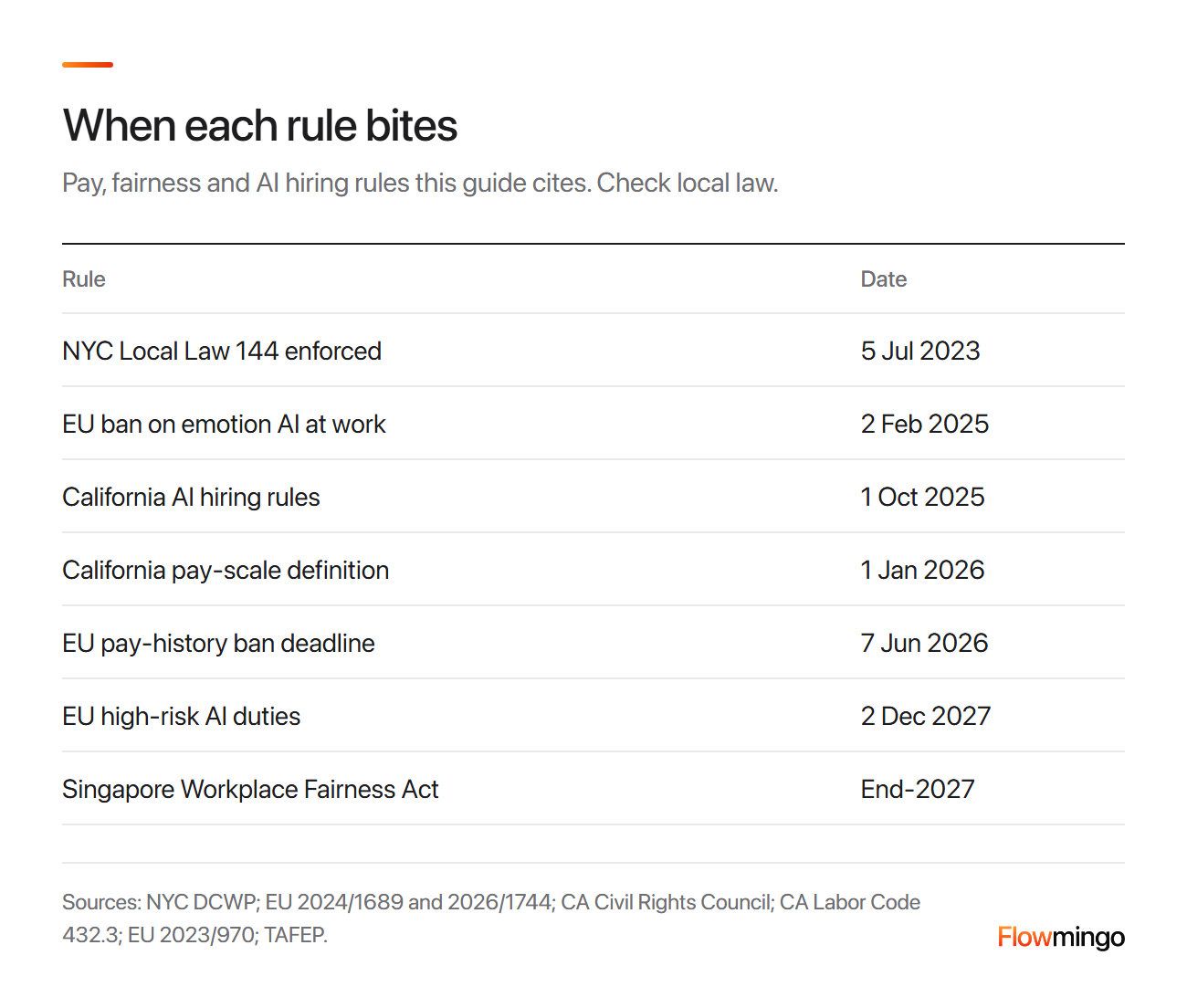
When each screening rule bites: pay, fairness and AI hiring rules from July 2023 to end-2027.
9. Is it legal to let AI screen my candidates?
Yes, but New York City, Illinois, California and the EU attach duties on audits, notice, consent and disability questions. Keep a human on every decision.
These laws share 1 idea: candidates should know when software judges them. So note what your AI screen assesses, and who reviews its results.
For covered automated employment decision tools in New York City, Local Law 144 requires a yearly independent audit for bias, with a public summary. Required notices include 10 business days' advance notice to covered NYC candidates and employees.
Coverage includes using the output alone, above every other criterion, or to overrule other conclusions. Check DCWP's scope and notice rules: human review alone is not an exemption.
Illinois requires notice, an explanation of what the AI checks, and consent before AI analyses a video interview.
California's rules, in force since 1 October 2025, warn that an automated test drawing out disability information may be an unlawful medical inquiry. In plain terms, a test that reveals a disability can count as a health question.
The EU AI Act lists recruitment AI as high-risk, and Regulation 2026/1744 moved its full duties to 2 December 2027. For you, that means telling candidates, informing workers' representatives and keeping logs.
Ask any vendor 3 questions:
- Does it infer emotions from face or voice, which the EU has banned at work since 2 February 2025?
- Can candidates be told it's in use and get an explanation of its role in a decision?
- Does it keep logs for at least 6 months?
10. What should happen after the screen so I don't lose good candidates?
Advance, hold or decline each candidate against the advance line on your scorecard within days, and tell every candidate the outcome. Candidates are pickier now: only 48% accepted their most recent offer in 4Q25, down from 85% in 4Q23 (Gartner).
Speed matters because your best applicants are talking to other employers too. Say your advance line, the lowest total that earns an interview, is 12 out of 16.
In that example, anyone at 12 or more gets an interview invite within 2 working days. Scores of 10 or 11 go on hold, in case your top group thins out. Everyone else gets a clear, kind no.
Then check your knockouts. US rules count even "informal or casual interviews and unscored application forms" as selection procedures (29 CFR 1607). That means the law treats a plain yes-or-no question like a test.
Say 60 of 100 men but only 40 of 100 women pass a knockout. Divide 40% by 60% and you get 67%. Federal agencies generally treat anything under 80% as evidence of adverse impact, a warning sign you'd need to justify by the job's real needs.
None of this makes saying no pleasant, but it makes each decision easier to explain.
How Flowmingo helps
To run the scored questions as an AI interview each applicant takes in their own time, try Flowmingo for your pre-screening interview questions.
11. Sources
Every study, law and quote in this guide links to a source below; Flowmingo figures come from Flowmingo's own platform data.
- Barach, M. A., & Horton, J. J. (2021). How do employers use compensation history? Evidence from a field experiment. Journal of Labor Economics.
- Bock, L. (2015). Work Rules! Insights from Inside Google That Will Transform How You Live and Lead. Hachette Book Group.
- Bohnet, I. (2016). How to take the bias out of interviews. Harvard Business Review.
- Bohnet, I., van Geen, A., & Bazerman, M. (2016). When performance trumps gender bias: Joint vs. separate evaluation. Management Science.
- California Civil Rights Council (2025). Civil Rights Council secures approval for regulations to protect against employment discrimination related to artificial intelligence. California Civil Rights Department.
- California Legislature (2025). Labor Code section 432.3, as amended by SB 642. California Legislative Information.
- California Legislature (2017). Government Code section 12952, California Fair Chance Act. California Legislative Information.
- Equal Employment Opportunity Commission and others (1978). Uniform Guidelines on Employee Selection Procedures, 29 CFR Part 1607. eCFR.
- European Parliament and Council (2023). Directive (EU) 2023/970 on pay transparency. Official Journal of the European Union.
- European Parliament and Council (2024). Regulation (EU) 2024/1689, the Artificial Intelligence Act. Official Journal of the European Union.
- European Parliament and Council (2026). Regulation (EU) 2026/1744, the Digital Omnibus on AI. Official Journal of the European Union.
- Frieder, R. E., Van Iddekinge, C. H., & Raymark, P. H. (2016). How quickly do interviewers reach decisions? An examination of interviewers' decision-making time across applicants. Journal of Occupational and Organizational Psychology.
- Gartner (2026). Gartner HR research finds 48% of candidates accepted job offers in 4Q25. Gartner newsroom.
- Gartner (2025). Gartner survey shows just 26% of job applicants trust AI will fairly evaluate them. Gartner newsroom.
- Greenhouse (2026). The Hire Standard: hiring benchmarks 2026. Greenhouse.
- Google re:Work Editorial Team (2026). A guide to structured interviewing for better hiring practices. Google re:Work.
- Greenhouse (2026). 63% of job seekers have faced an AI interview. Most haven't had a good one yet. Greenhouse 2026 Candidate AI Interview Report.
- Illinois General Assembly (2019). Artificial Intelligence Video Interview Act, 820 ILCS 42. Illinois Compiled Statutes.
- Kahneman, D. (2002). Daniel Kahneman, biographical. Nobel Prize Outreach.
- Kahneman, D., Sibony, O., & Sunstein, C. R. (2021). Noise: A Flaw in Human Judgment. Little, Brown Spark.
- Levashina, J., & Campion, M. A. (2007). Measuring faking in the employment interview: Development and validation of an interview faking behavior scale. Journal of Applied Psychology.
- NYC Department of Consumer and Worker Protection (2023). Automated Employment Decision Tools. City of New York.
- Orji, K., & Bangerter, A. (2025). Tick tock, tick tock, time's up! How response time limits in asynchronous video interviews influence interview anxiety, impression management, and performance. International Journal of Selection and Assessment.
- Sackett, P. R., Zhang, C., Berry, C. M., & Lievens, F. (2022). Revisiting meta-analytic estimates of validity in personnel selection: Addressing systematic overcorrection for restriction of range. Journal of Applied Psychology.
- Smart, G. (2016). How to quickly interview and weed out bad candidates. [Video]. YouTube.
- Smart, G., & Street, R. (2008). Who: The A Method for Hiring. Ballantine Books.
- Tilston, O., Krings, F., Roulin, N., Bourdage, J. S., & Fetzer, M. (2024). Reactions to asynchronous video interviews: The role of design decisions and applicant age and gender. Human Resource Management.
- Tripartite Alliance for Fair and Progressive Employment Practices (n.d., read 2026). Fair job and employment application forms. TAFEP.
- Tripartite Alliance for Fair and Progressive Employment Practices (n.d., read 2026). Workplace Fairness Legislation. TAFEP.
- UK Parliament (2010). Equality Act 2010, section 60. legislation.gov.uk.
- United States Code (current text). 42 USC 12112, Americans with Disabilities Act. Legal Information Institute.
- Van Iddekinge, C. H., Arnold, J. D., Frieder, R. E., & Roth, P. L. (2019). A meta-analysis of the criterion-related validity of prehire work experience. Personnel Psychology.