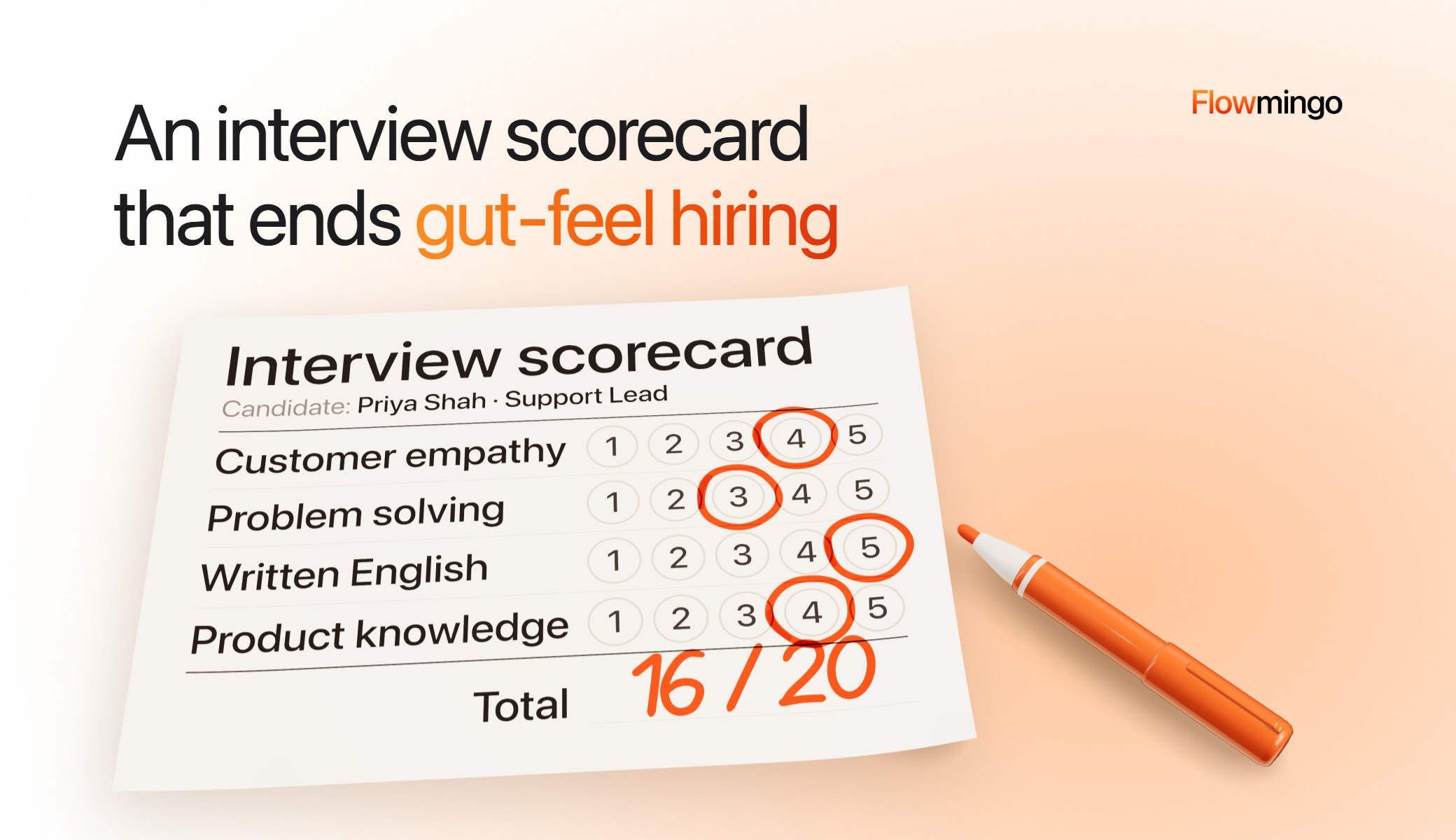
3 interviewers, 1 finalist, 3 verdicts. Without an interview scorecard, the loudest voice in your debrief picks the hire.
There is no candidate evaluation form to go back to. So nobody can explain the offer to your CEO, or to a rejected candidate who asks.
Without a shared form, busy people fall back on gut feel.
And gut calls are weaker than they feel, as Noise by Kahneman and his co-authors shows.
Say all you know is that 1 candidate interviewed better than another. The chance they really are the better hire is only 56% to 61%, barely better than a coin flip.
A scorecard fixes this in 3 moves. Every interviewer scores the same 4 to 6 skills against written examples, alone, before the debrief. Then the total decides, unless a must-have fails.
Key takeaways
- Does a scorecard really lead to better hires? Yes, if every interviewer scores the same skills against written examples. Interviews run this way predicted job performance about twice as well as free-form ones in a 2022 review.
- How many skills should it score? 4 to 6, each on a 1-to-5 scale with a written example answer per level. Any must-have below 3 means no hire.
- How do I pick between 2 finalists who tie? Check the must-haves first, then debrief any 2-against-5 split on evidence. Don't re-vote on feel: a fixed formula beat expert judgment in a 2013 review.
- How many interviewers do I need? Up to 4, each scoring alone. In Google's own data, every interview after the 4th added less than 1% accuracy.
- Can I trust the AI score? Use it as 1 input and read its reasons. In a 2023 study, an AI rater tracked trained human raters closely on familiar questions and poorly on new ones.
1. Does an interview scorecard actually help me pick better hires?
Yes, when every interviewer scores the same skills against written examples. Structured interviews, where you ask and score everyone the same way, predicted job performance at 0.42, more than twice the 0.19 of unstructured ones.
Those figures come from Sackett and colleagues' foundational 2022 re-analysis of decades of hiring research.
The numbers are correlations, from 0 (no link to later job performance) to 1 (a perfect link). So 0.19 doesn't mean unstructured interviews pick right 20% of the time. It means their link to later performance is weak.
The chart below ranks 6 common methods. Job knowledge tests at 0.40 and keyed biodata, a scored background questionnaire, at 0.38 come close behind.
Work sample tests follow at 0.33 and cognitive ability tests at 0.31. Unstructured interviews, the free-form chat most of us grew up with, come last.
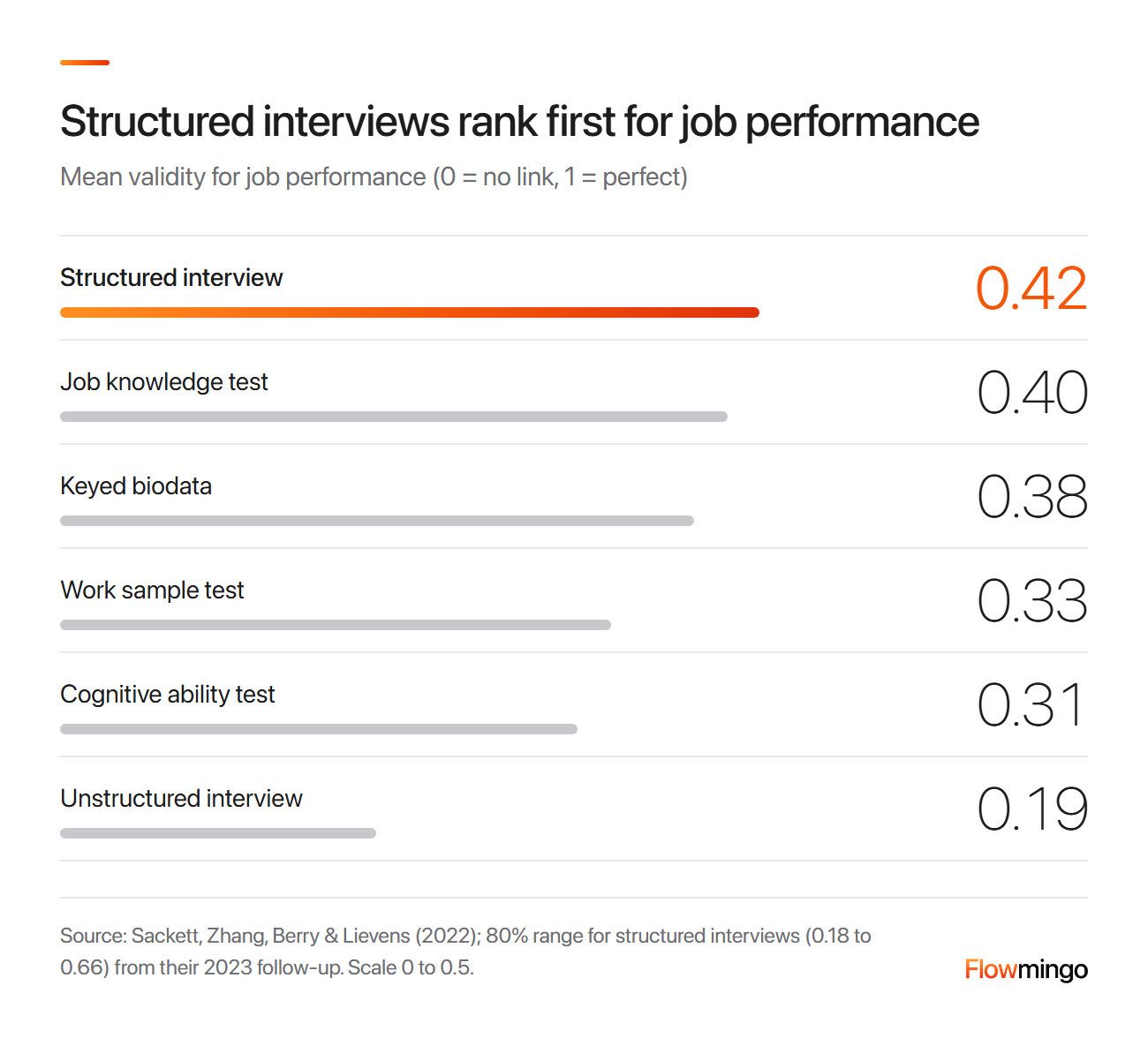
Hiring methods ranked by link to job performance: structured interviews lead at 0.42, unstructured interviews trail at 0.19 (foundational Sackett et al. re-analysis).
But 0.42 is an average. The authors' follow-up puts most structured interviews between 0.18, no better than a free-form chat, and 0.66, better than anything on the chart.
Design is 1 of 3 reasons the authors give for that spread. This means an interview scorecard with vague skills risks landing near the bottom. These are averages across many employers, not a promise about your next hire.
2. What should my interview scorecard template include?
An interview scorecard template, or candidate evaluation form, includes 5 skills, written anchors, an evidence box and a must-have floor, all on 1 page. It ends with an overall impression and a recommendation.
The anchors make 1 interviewer's 4 mean the same as another's, and the evidence box answers "why" when your CEO asks.
The floor stops a strong total from hiding a weak must-have. The overall impression comes last, because a gut feeling written first colors every skill score after it.
Here is that form for a customer support lead, with 2 must-haves. Each of the 5 skills scores 1 to 5, so the total is out of 25.
Ask 2 past-behavior questions per skill, because a real past example gives you something concrete to hold against the anchors. For example: "Tell me about the last time an upset customer escalated to you."
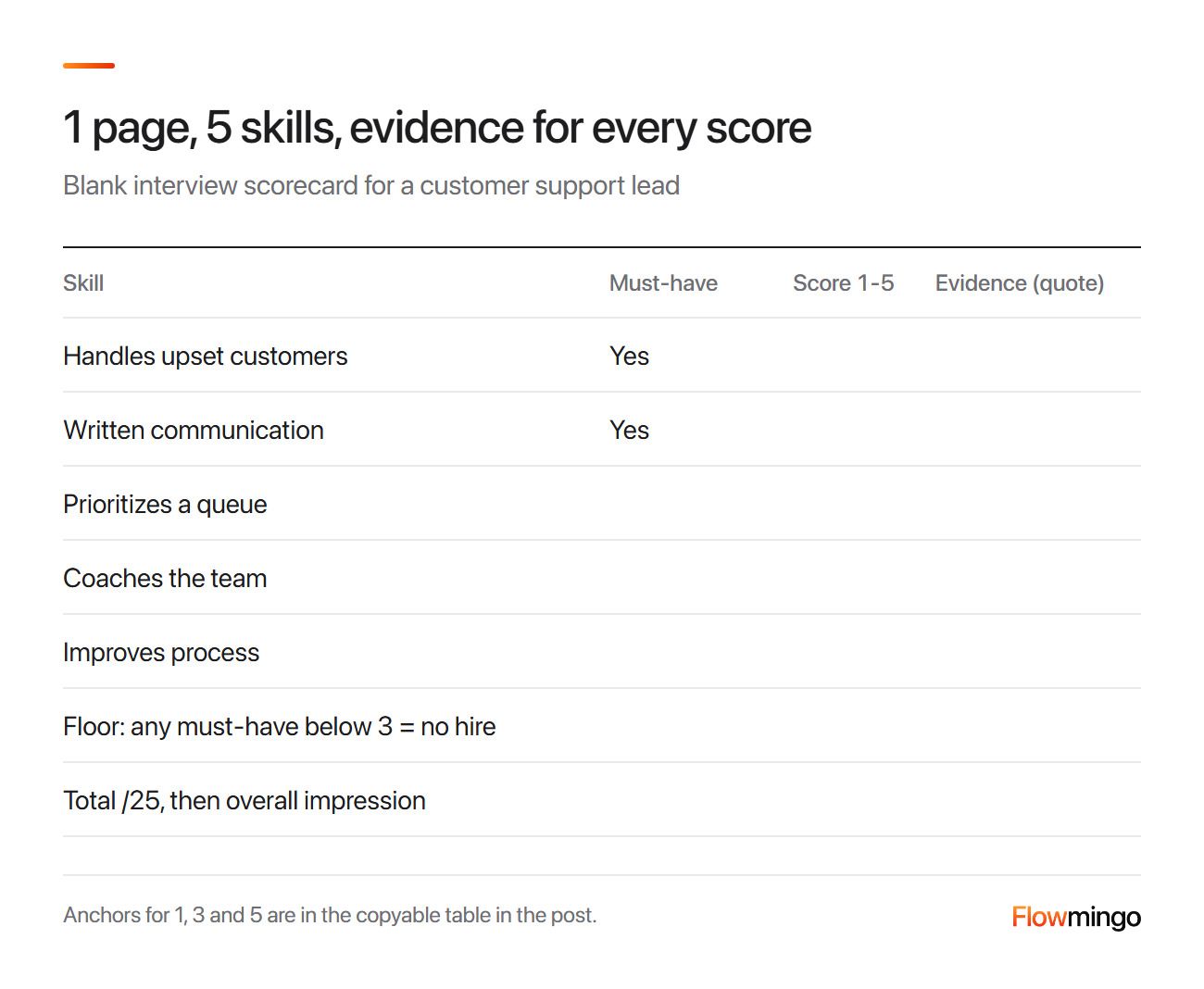
Blank interview scorecard template for a customer support lead: 5 skills, 2 must-haves, a 1 to 5 score and an evidence quote each.
Copy the table, then swap in your own skills and anchors.
| Skill | Anchors for 1 / 3 / 5 | Score 1-5 | Evidence (quote) |
|---|---|---|---|
| Header | Candidate, role, interviewer, date | ||
| Handles upset customers (must-have) | Blames the customer / applies policy / fixes the cause | ||
| Written communication (must-have) | Unclear / clear but long / short and clear | ||
| Prioritizes a queue | No method / by urgency / by impact | ||
| Coaches the team | No example / gives tips / sets a plan | ||
| Improves process | No example / suggests a fix / ships a fix | ||
| Must-have floor | Any must-have below 3 means no hire | ||
| Not scored | Emotions read from face, voice or typing; accent or pace unless the job needs it; "culture fit" | ||
| Total | Sum of 5 scores, out of 25 | ||
| Overall impression | 1 to 5, filled in last | ||
| Recommendation | Strong hire / hire / no hire / strong no hire; an override needs a written reason |
2.1 What should I decide before I build it?
Define success in the role first, then pick the skills that deliver it. Freeze the interview scorecard before the first CV arrives.
That order comes from Who, by Geoff Smart and Randy Street. Write 1 mission line, then 3 to 8 outcomes ranked by importance, then 4 to 6 skills. An outcome is a measurable result, like growing revenue from $25 million to $50 million by year 3, not an activity.
Freezing matters because people bend criteria without noticing. In the foundational Uhlmann and Cohen (2005) studies, participants judged a streetwise and a highly educated applicant for police chief.
Whichever strength the man had, they decided the job needed it more, and the woman got no such boost. Committing to the criteria before seeing the applicants removed that bias. So a scorecard written after you meet candidates can quietly bend toward the one you already like.
2.2 Should culture fit be on the scorecard?
Not as written, because nobody can score it the same way twice. Turn it into 1 or 2 observable behaviors, such as "asks for feedback on their own work".
Say your team values candor: score "gave a specific example of flagging a mistake early" instead.
3. How do I weight interview scores so the must-haves count most?
Give every skill equal weight and add a must-have floor, or fix the weights before the first interview. Equal weights often predict new cases as well as weights fitted to past data.
That second point comes from the psychologist Robyn Dawes, as Kahneman summarizes it in Thinking, Fast and Slow.
Weights tuned to your past hires also learn that group's accidents. Say your 3 best support hires all happened to be strong coaches: a tuned weight would favor coaching in every future candidate.
Equal weights can't chase an accident like that, which is why they often predict new candidates just as well. Keep the skills independent too, as Kahneman advises: don't list both "communication" and "presentation skills", because together they count the same thing twice.
A must-have gets its force from the floor, not from a bigger weight. Say "Handles upset customers" scores 2 and every other skill scores 5.
The total of 22 out of 25 looks great, yet the floor still says no hire. That's what you want for a skill the job can't do without.
If you do weight, write them on the interview scorecard up front and apply them to everyone. That closes the easiest way to bend a total: changing weights after you meet someone you like.
How Flowmingo helps
Flowmingo's AI interview report uses fixed weights: a Must Have criterion counts 4 times a Good to Have one in the overall score. Each criterion keeps its own 0 to 10 score, so you can still apply a must-have floor yourself.
4. How do I make a 3 mean the same thing to every interviewer?
Write what a 1, a 3 and a 5 answer contains for each skill, before the first interview. That behaviorally anchored rating scale makes 2 interviewers' scores comparable.
"Behaviorally anchored" just means each score ties to what the candidate did, not to a feeling like "pretty good". Without anchors, a 3 on the same interview scorecard means "fine" to 1 interviewer and "weak" to another.
Anchored interviews also show stronger average links to later performance. Taylor and Small's foundational review of 19 past-behavior interview studies found a link of .35 with anchored scales, against .26 without. The studies differed in other ways too, so this comparison does not isolate the effect of adding anchors.
Here is the interview rating scale for the must-have "Handles upset customers".
| Score | What the answer contains |
|---|---|
| 1 | Blames the customer; no action of their own and no outcome |
| 3 | A real example: calms the customer and applies policy, but never checks the result |
| 5 | A real example: finds the cause, fixes it, follows up and shares the fix |
Each step up is something you can hear in the answer. That's why 2 listeners can land on the same number.
If you can't write anchors yet, borrow the 5 levels in the structured interview guide from OPM, the US federal HR agency. Each turns on how difficult the situation was and how much guidance the person needed.
- 1, Awareness: the simplest situations, with close and extensive guidance.
- 2, Basic: somewhat difficult situations, with frequent guidance.
- 3, Intermediate: difficult situations, with occasional guidance.
- 4, Advanced: considerably difficult situations, with little or no guidance.
- 5, Expert: exceptionally difficult situations, where the person advises others.
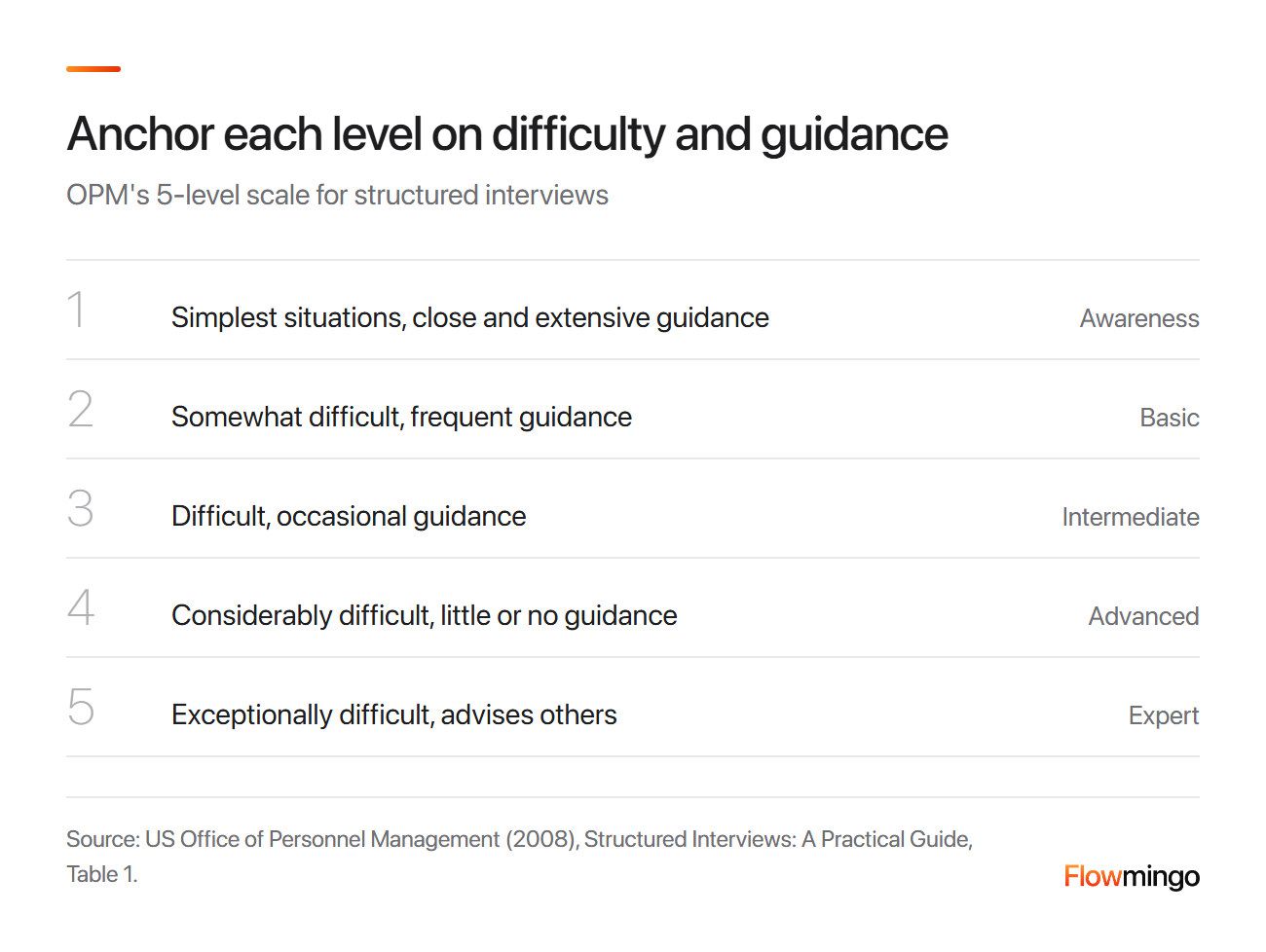
OPM's 5 rating levels for structured interviews: from Awareness (simplest situations, close guidance) to Expert (exceptionally difficult situations, advises others).
5. How do I choose between 2 strong finalists when my interviewers disagree?
Let the interview scorecard total decide, with 2 exceptions: a must-have below 3, or a 2-against-5 split, which you debrief on evidence. Don't re-vote on feel.
This is the moment scorecards exist for, and the moment it's most tempting to drop them. Here is an illustrative example, not customer data: 3 support lead finalists, each cell averaged across 3 interviewers.
| Skill | A | B | C |
|---|---|---|---|
| Handles upset customers (must-have) | 4 | 2 | 4 |
| Written communication (must-have) | 4 | 4 | 3 |
| Prioritizes a queue | 3 | 4 | 3 |
| Coaches the team | 3 | 4 | 4 (scores 2, 5, 5) |
| Improves process | 4 | 4 | 3 |
| Total, out of 25 | 18 | 18 | 17 |
| Decision | Hire | No hire: floor fires | Debrief the split |
Read the interview scorecard row by row. A and B tie at 18 out of 25. But B scored 2 on a must-have, so the floor fires and B is a no hire.
C totals 17, but C's average of 4 on "Coaches the team" hides a split: 1 interviewer gave 2, and the other 2 gave 5. That gap becomes the debrief's only agenda item.
In practice, ask each side to read out their evidence quotes. Say the low scorer heard about a team member who quit, and the others heard about a coaching plan that worked. The debrief decides which story is more typical of C, and anyone who missed evidence changes the score in writing.
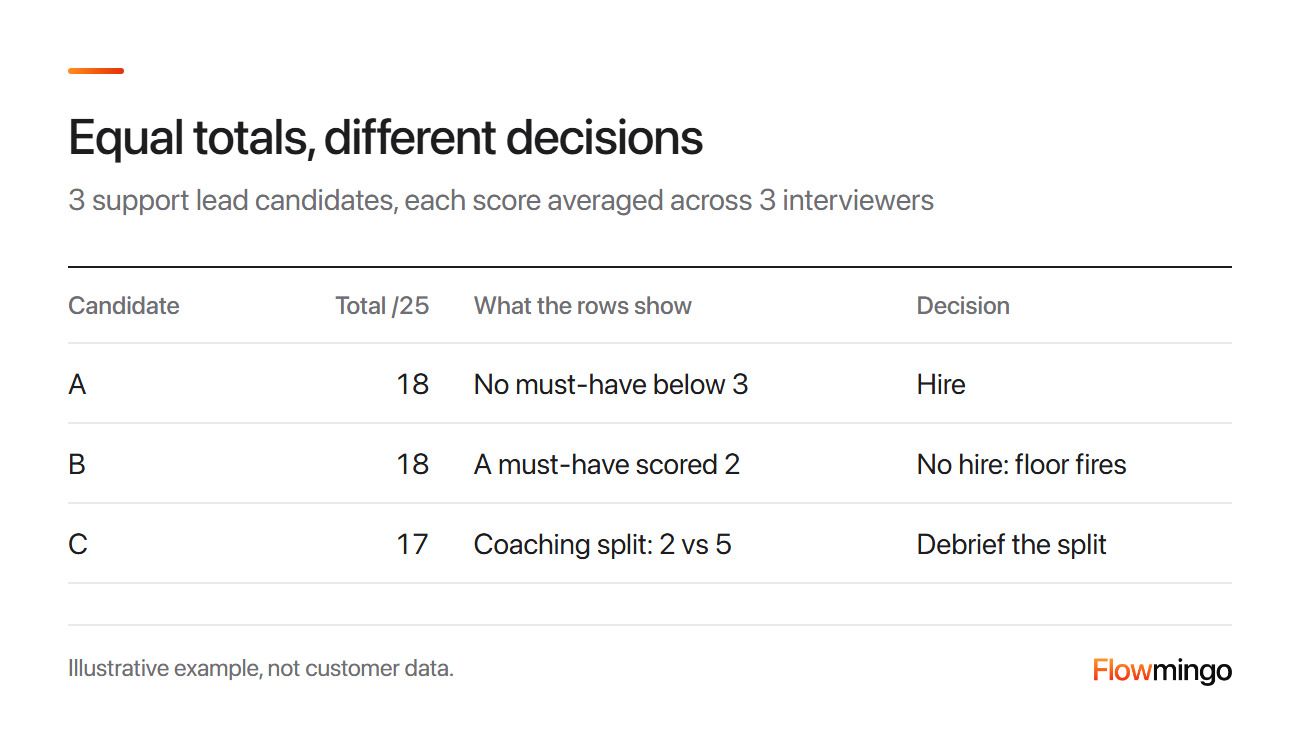
Filled-in interview scorecard, illustrative: A and B tie at 18 of 25, B misses a must-have, and C has a coaching split to debrief.
5.1 What if my gut says one thing and the scores say another?
Go with the scores unless you can write down the evidence they missed. In Kuncel and colleagues' foundational 2013 meta-analysis, a formula applied the same way to everyone predicted job performance at 0.44, against 0.28 for holistic judgment. The authors call that an improvement in prediction of more than 50%, even against experts who knew the job.
Holistic judgment means people weighing the same facts in their heads, including consensus meetings. So the debrief fills evidence gaps, and doesn't re-vote.
5.2 Should I compare finalists side by side?
Yes, answer by answer. Bohnet's HBR advice is to compare all answers to question 1, then question 2, so you judge each answer against the others.
In a foundational 2016 lab study, people shown 1 candidate at a time leaned toward the gender the task's stereotype favored. Past performance barely mattered. Shown 2 side by side, they picked the higher performer 54% of the time and the lower one 8%.
The study used past task scores, not interviews, so treat it as a strong hint rather than proof.
6. How do I stop the loudest interviewer from winning the debrief?
Have every interviewer submit their interview scorecard before anyone talks, then open the debrief with the scores.
Say a senior person opens with "I loved her", and the room starts to drift toward that view. Scores written alone protect everyone from that pull, which is why Noise makes independent scoring a hiring rule.
In practice, collect scores in a shared sheet or your applicant tracking system, and reveal them all at once.
A panel, where everyone watches the same interview, looks like a fix. In Huffcutt and colleagues' foundational 2013 meta-analysis, panel raters agreed at 0.74, against 0.44 for separate interviews, on a 0-to-1 scale.
That number flatters panels. Panelists all score the same performance on the same day, so if the candidate had an unusually good or bad morning, they all see it.
As Iris Bohnet put it in a talk at Google, "the sample size of a panel interview is basically one". Separate interviews, each scored alone, give you more independent looks.
6.1 How many interviewers should score each candidate?
Up to 4, in separate interviews. In Google's internal data, not a peer-reviewed study, 4 interviews predicted the hire decision with 86% confidence. Each extra one added less than 1%.
Extra interviews added little to predicting Google's own hiring decision. Use that as a prompt to justify each round, not a universal maximum or evidence about later job performance.
7. How do I get busy interviewers to actually fill in the interview scorecard?
Make scoring part of the interview. Score each skill right after its questions, write a 1-line quote as evidence, and give the overall impression last.
Nobody wants another form after a day of interviews. That's why scoring happens inside the interview, not as homework for tonight.
Kahneman built this method for the Israeli army in 1955, after free-form interviews proved almost useless at predicting success. Interviewers scored 6 traits on a 1-to-5 scale, finishing each before starting the next, so a first impression couldn't color the rest.
Only then did they close their eyes and give an overall rating, and the total predicted much more accurately than before. His advice: hire the top total, "even if there is another one whom you like better".
Timing matters too. In a field study, 166 interviewers reported when they made up their minds. Only 4.9% of decisions came in the first minute, but 22.5% came after the interview had ended.
A decision made after the candidate leaves rests on memory, so score as you go.
For our support lead, that looks like this:
- Ask the 2 queue questions, then score "Prioritizes a queue" before moving on.
- Write 1 quote as evidence, such as "I sort bugs by how many customers they touch."
- Keep the same skill order for every candidate.
Written evidence is rare in our data.
Flowmingo data · 86,638 AI-interviewed candidates · 2,574 companies · Jul 2025 to Sep 2026
- 0.3% of AI-interviewed candidates got a written comment from the hiring team (258 of 86,638).
Teams may keep notes elsewhere; inside Flowmingo, the AI report is usually the only written evaluation on file.
A written reason is the first thing to skip on a busy day. That's why the form asks for just 1 quote per skill.
8. Can I trust an AI score on my interview scorecard?
Use it as 1 input a person reviews, and read its reasons first. AI scoring can drop sharply on questions it was not trained for.
We have a stake in this answer, so the evidence below includes the part that doesn't flatter AI.
In a foundational 2023 study, 2 trained raters scored 7,017 applicant answers on a 1-to-5 anchored scale. A model trained on the same questions matched their scores closely, at 0.75 on a 0-to-1 scale. On question formats it had never seen, it fell to 0.30, a weak match.
This means an AI score is only as good as its question-specific rubric, so read its reasons before you trust the number. Also note that 3 of that study's 5 authors worked at the AI-interview vendor Modern Hire.
How Flowmingo helps
Flowmingo's AI Interviewer scores against criteria you approve. AI drafts the questions and criteria from your job description, and you edit both. You send each applicant the interview to do in their own time.
You get back the recording, the transcript and each criterion rated 0 to 10 with a written justification. You make the hiring decision.
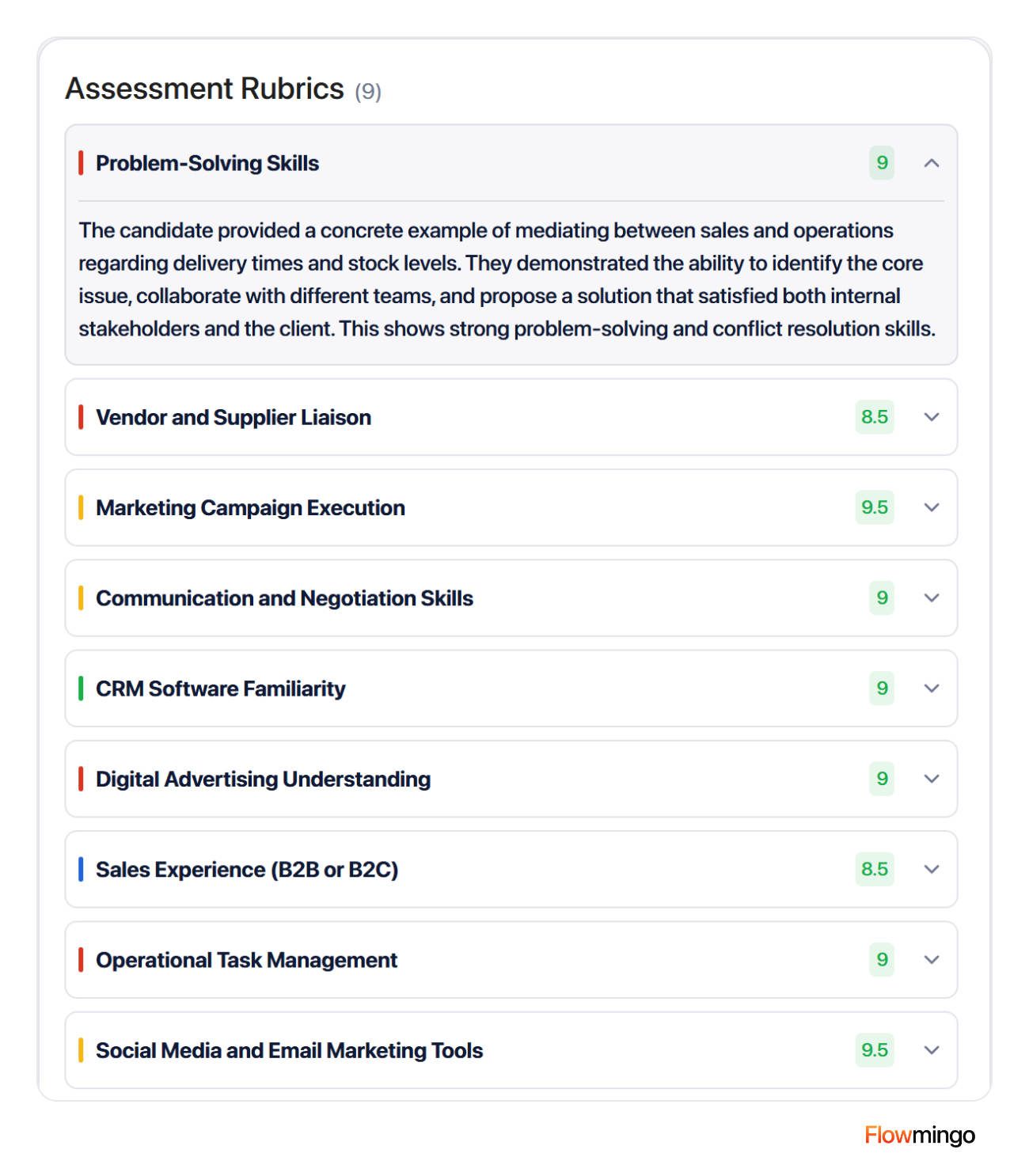
Flowmingo's public sample report: a 0 to 10 score and reason per criterion, so set any must-have floor on that scale.
In our data, the CV and the interview also disagree about who is best.
Flowmingo data · 34,114 candidates · 379 companies · Jul 2025 to Sep 2026
- 19.2% of 532 projects with 1 clear top interview score also gave that candidate the top CV score.
- 54.9% of the 3,684 candidates who scored 8 or more in the interview (2,022) would have been cut by a top-20% CV shortlist.
Both are Flowmingo AI scores, not job performance, and interviewees are a selected group. The data shows the 2 rankings differ, not which one is right.
In plain terms, in about 4 of every 5 of those projects, the top interview scorer did not also have the top CV score. So score the interview on its own, rather than let the CV score carry over.
9. Will my scorecards protect me if a rejected candidate complains?
They help, if they score job-related evidence and you keep them. On a reasonable reading, US federal rules mean keeping scorecards at least 1 year, and California's rules 4 years.
A complaint can arrive months later, when nobody remembers the interview. An interview scorecard with a quote per skill shows what you assessed and why.
The US rule doesn't name scorecards, but it covers "other records having to do with hiring". Once someone files a discrimination charge, you keep every relevant record until the case ends. That includes other candidates' records for the same job, so 1 charge freezes the whole set.
These rules stand as of September 2026. This is a summary, not legal advice.
| Rule | Where | What it means for your scorecard |
|---|---|---|
| 29 CFR 1602.14 | US | Keep hiring records 1 year, longer after a charge |
| 2 CCR 11013(c) | California | Keep records 4 years, including automated-decision data |
| ICO guidance | UK | Candidates can request interview notes; disclose any tie-break rule |
| TAFEP | Singapore | Use an evaluation form and keep records at least 1 year |
| 29 CFR 1630.11 (ADA) | US | If a disability affects speech, score the skill, not the speech, unless speaking is what the job requires |
| AI Act, Article 5(1)(f) | EU, since 2 Feb 2025 | No AI inferring candidates' emotions from faces, posture or keystrokes |
| AI Act, Annex III and Article 26 | EU, from 2 Dec 2027 | High-risk: human oversight, logs kept 6+ months, candidates told |
| Local Law 144 | New York City | An AI score used alone, weighted above everything else or used to overrule people: yearly audit for bias and notice |
| AI Video Interview Act | Illinois | Notice, explanation and consent first; delete videos within 30 days of a request |
That's why the template has a "Not scored" row. The EU bans AI that reads candidates' emotions from faces, posture or keystrokes, and the US disability law (ADA) protects candidates whose disability affects speech. In the UK, candidates can ask for your notes, so write each evidence line as if they will read it.
To self-audit, compare pass rates by group with the 4/5 rule of thumb in the Uniform Guidelines. Say 30% of 1 group passes and 50% of another: 30 divided by 50 is 0.6, below 0.8, so look closer.
A June 2026 Justice Department opinion and a July 2026 OPM rule move federal agencies away from the Guidelines. They remain in the federal regulations, though, so treat the check as a cheap habit, not a legal line.
10. How do I roll out an interview scorecard with my team this week?
Build it in this order, and change it only between roles. A first version doesn't need to be perfect, but it must be the same for every candidate.
- Write 1 mission line and 3 to 8 ranked outcomes.
- Turn them into 5 skills and mark the must-haves.
- Write 2 past-behavior questions and anchors for 1, 3 and 5 per skill.
- Have up to 4 interviewers score alone and submit before the debrief.
- Let the total decide, but any must-have below 3 means no hire. Write down every override.
In practice, start with 1 open role, so your team learns the habit on something real. Before the first interview, have everyone score the same sample answer and compare.
If 2 scores sit more than 1 point apart, rewrite the anchor until they agree. The trained raters in the section 8 study used the same 1-point gap to call a meeting.
Expect some pushback. Kahneman's army interviewers resisted just recording answers too, and his fix was the close-your-eyes rating, which gave their judgment a place on the form. Your overall impression line does that for your team.
How Flowmingo helps
To send every applicant a structured interview to do in their own time, recorded and scored against 1 interview scorecard, try Flowmingo.
11. Sources
Every external figure above comes from the sources below, in order of appearance. Flowmingo's own figures sit in the data boxes, Jul 2025 to Sep 2026.
- Sackett, P. R., Zhang, C., Berry, C. M., & Lievens, F. (2022). Revisiting meta-analytic estimates of validity in personnel selection: Addressing systematic overcorrection for restriction of range. Journal of Applied Psychology.
- Sackett, P. R., Zhang, C., Berry, C. M., & Lievens, F. (2023). Revisiting the design of selection systems in light of new findings regarding the validity of widely used predictors. Industrial and Organizational Psychology.
- Kahneman, D., Sibony, O., & Sunstein, C. R. (2021). Noise: A flaw in human judgment, ch. 24, as quoted by NPR Planet Money. Little, Brown Spark.
- Smart, G., & Street, R. (2008). Who: The A method for hiring. Ballantine Books.
- Uhlmann, E. L., & Cohen, G. L. (2005). Constructed criteria: Redefining merit to justify discrimination. Psychological Science.
- Taylor, P. J., & Small, B. (2002). Asking applicants what they would do versus what they did do: A meta-analytic comparison of situational and past behaviour employment interview questions. Journal of Occupational and Organizational Psychology.
- US Office of Personnel Management (2008). Structured interviews: A practical guide. OPM.
- Kahneman, D. (2011). Thinking, fast and slow, ch. 21, "Intuitions vs. formulas". Farrar, Straus and Giroux.
- Frieder, R. E., Van Iddekinge, C. H., & Raymark, P. H. (2016). How quickly do interviewers reach decisions? Journal of Occupational and Organizational Psychology. Percentages as reported by BPS Research Digest.
- Shaper, S. (2017). How many interviews does it take to hire a Googler?. Google re:Work, archived.
- Huffcutt, A. I., Culbertson, S. S., & Weyhrauch, W. S. (2013). Employment interview reliability: New meta-analytic estimates by structure and format. International Journal of Selection and Assessment.
- Bohnet, I. (2016). What works: Gender equality by design. Talks at Google.
- Bohnet, I. (2016). How to take the bias out of interviews. Harvard Business Review.
- Bohnet, I., van Geen, A., & Bazerman, M. H. (2016). When performance trumps gender bias: Joint vs. separate evaluation. Management Science.
- Kuncel, N. R., Klieger, D. M., Connelly, B. S., & Ones, D. S. (2013). Mechanical versus clinical data combination in selection and admissions decisions: A meta-analysis. Journal of Applied Psychology.
- Koenig, N., Tonidandel, S., Thompson, I., Albritton, B., Koohifar, F., et al. (2023). Improving measurement and prediction in personnel selection through the application of machine learning. Personnel Psychology.
- European Commission (2025). Guidelines on prohibited artificial intelligence practices, C(2025) 5052 final. European Commission.
- European Parliament and Council (2026). Regulation (EU) 2026/1744, the Digital Omnibus on AI. Official Journal of the EU.
- NYC Department of Consumer and Worker Protection (2023). Automated employment decision tools: rules and FAQ. NYC DCWP.
- Illinois General Assembly (n.d.). Artificial Intelligence Video Interview Act, 820 ILCS 42. Illinois General Assembly.
- US Equal Employment Opportunity Commission (1991, as amended 2011). 29 CFR 1630.11, Administration of tests. eCFR.
- US Equal Employment Opportunity Commission (1972, as amended 2024). 29 CFR 1602.14, Preservation of records made or kept. eCFR.
- California Civil Rights Council (2025). Employment regulations regarding automated-decision systems. California Civil Rights Department.
- Information Commissioner's Office (n.d., under review). Shortlisting, testing, and interviewing candidates. ICO.
- TAFEP (n.d., accessed 2026-09-24). How to conduct fair job interviews. Tripartite Alliance for Fair and Progressive Employment Practices.
- EEOC, Civil Service Commission, Department of Labor & Department of Justice (1978). Uniform Guidelines on Employee Selection Procedures, 29 CFR Part 1607. eCFR.
- US Department of Justice, Office of Legal Counsel (2026). Constitutionality of disparate-impact liability under Title VII. DOJ.
- US Office of Personnel Management (2026). Removal of references to the Uniform Guidelines on Employee Selection Procedures in federal personnel regulations. Federal Register.